White House Drafts Plan to Ask Congress to Claw Back Public Media Funding
The Trump administration is preparing a memo asking lawmakers to rescind roughly $1.1 billion in funding for the Corporation for Public Broadcasting, which helps support NPR and PBS.
By Kendra Konchanuk ·
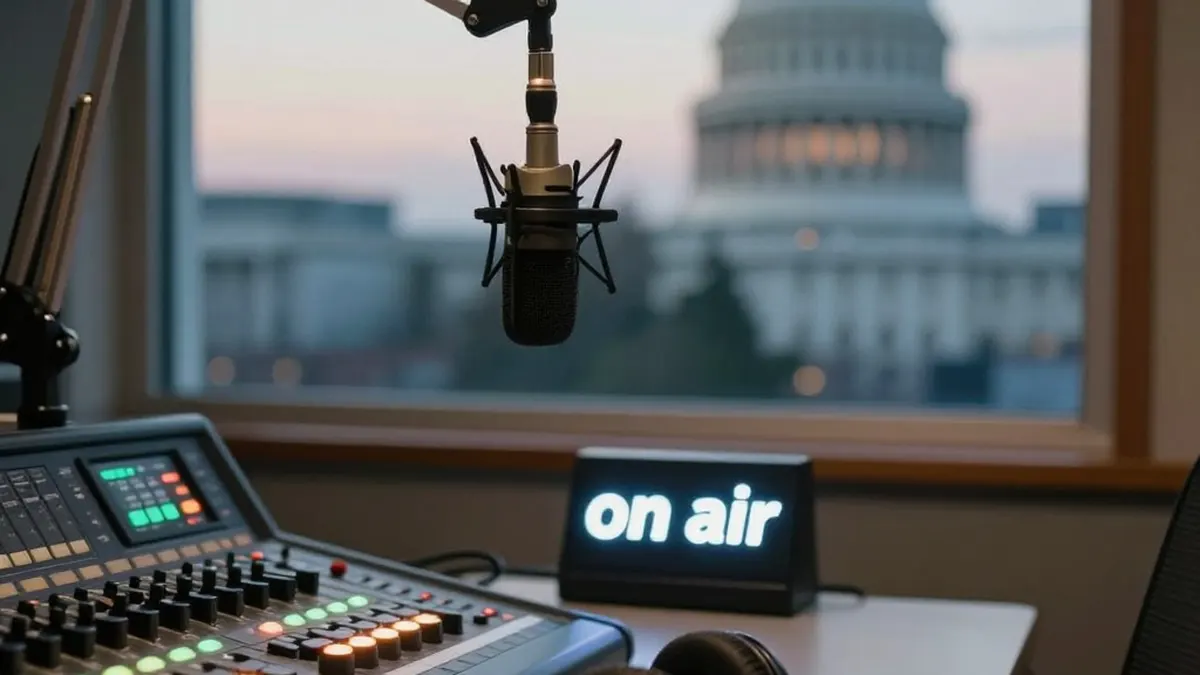
The Trump administration has drafted a memo to Congress laying out its intention to end nearly all federal funding for public media, including support that reaches NPR and PBS. A White House official, speaking to NPR on condition of anonymity, confirmed the draft exists.
The administration plans to send the memo when Congress returns from recess on April 28. That would start a 45-day window in which the House and Senate can either approve the rescission or let the money be restored.
Trump is expected to seek the rescission of $1.1 billion, equal to two years of funding for the Corporation for Public Broadcasting (CPB). The CPB is a congressionally chartered, independent nonprofit that provides partial funding to NPR and PBS. Congress allocated $535 million for the CPB this fiscal year, a figure reaffirmed in a recent stopgap spending bill, and has appropriated funds through Sept. 30, 2027. The CPB's budgets run on a two-year cycle largely to shield it from political pressure.
In a Monday statement that did not mention the memo, the White House accused the two networks of spreading "radical, woke propaganda disguised as 'news.'" Earlier this month, Trump also urged Republicans on social media to defund and "totally disassociate" themselves from NPR and PBS. The move appears to draw on a late-March hearing of a House Oversight and Government Reform subcommittee, where the heads of both networks were questioned over claims that their coverage is biased against conservatives.
At that hearing, Rep. Marjorie Taylor Greene, who chairs the subcommittee, told the executives: "You can hate us all on your own dime." Republicans criticized NPR chief Katherine Maher over social media posts made before she became CEO in March 2024, and asked PBS CEO Paula Kerger about a video of a drag performer singing a children's song variation. Kerger testified that the video appeared only on a New York member station's website and never aired on television.
NPR said ending CPB funding would have a "devastating impact" on communities that depend on public radio for news, emergency alerts and public safety information. Kerger said the effort would "disrupt the essential service PBS and local member stations provide to the American people."
The financial picture varies by network. NPR receives about 1% of its funding directly from the federal government. Its 246 member institutions, which operate more than 1,300 stations, get on average 8% to 10% of their funds from the CPB. PBS and its stations draw about 15% of revenues from the CPB. Most CPB money goes to local stations, largely to subsidize television, which costs more than radio. Network leaders testified that losing it would wipe out smaller stations, especially in rural areas. Ed Ulman of Alaska Public Media said that without the networks, stories from Alaska would not reach a national audience.
Public opinion is split along party lines. A recent Pew Research Center poll found 43% of U.S. adults favor continued federal support for NPR and PBS while 24% say it should be cut. Among Republicans, 44% favor ending funding; 69% of Democrats want it to continue.
The proposal comes amid wider pressure on government-supported media. FCC Chair Brendan Carr has opened an investigation into whether NPR and PBS underwriting spots violate rules against commercial advertising, which the networks dispute. Courts have also intervened in disputes involving Voice of America and Radio Free Europe/Radio Liberty, while the administration has taken over the U.S. Institute of Peace, whose fired employees are now suing.
Source: Houston Public Media